

What are Fringe Benefits and How Can Employees Take Advantage?

Your salary might be the main form of compensation you get in your employment package, but that doesn’t mean it’s the only benefit available to you. From cashback on weekly shops to discounted gym memberships, bikes, technology, and flexible working, the benefits offered alongside pay can make a noticeable difference to your finances and overall wellbeing.
These extras are often known as fringe benefits, and they can go a long way on top of your salary. That’s why it’s no surprise that more than 7 out of 10 employees (72%) with access to 10 or more benefits say the quality of their benefits makes them more likely to stay with their employer.
But what are fringe benefits in practice? Which ones could be available to you, and how can you make sure you’re getting the full value from what your employer offers? Let’s dive deeper and learn more about how employees can take full advantage of the fringe benefits that might be accessible to them...
What are fringe benefits?
Fringe benefits are additional benefits or perks you receive from your employer on top of your regular salary or wages. They can range from financial benefits and workplace discounts to health support, flexible working arrangements, and salary sacrifice schemes. Some have an obvious monetary value, while others make life easier, support your wellbeing, or help you balance work with everything happening outside of it.
You may also hear certain fringe benefits described as benefits in kind. These are non-cash benefits provided by an employer, such as a company car or private medical insurance, rather than money paid directly through your salary. Some benefits in kind are taxable, while others are exempt, depending on the type of benefit.
Essentially, fringe benefits broadly refer to extras beyond your basic pay and statutory employment rights. Your employer may be legally required to provide certain entitlements, whereas many fringe benefits are voluntarily added to make the overall employment package more valuable.
The value can add up, with WTW's research finding that 37% of employees chose their current employer partly because of its benefits package, while 44% said benefits were a reason for staying.

What are examples of fringe benefits?
There's no single fringe benefits package that suits everyone. The most useful benefits are normally those that match the everyday needs of the people receiving them. Common examples include:
- Workplace discounts and cashback
- Cycle to Work schemes
- Gym membership discounts
- Health and wellbeing support
- Private medical insurance
- Flexible or hybrid working
- Enhanced annual leave
- Company cars or car schemes
- Technology and homeware schemes
- Learning and development opportunities
- Enhanced parental benefits
- Employee assistance programmes
For example, BHN Extras brings a range of money-saving workplace benefits like these together in one platform, helping employees turn their benefits into practical everyday savings. That could mean earning cashback on purchases, saving on a new bike and eligible cycling equipment, or accessing discounted gym memberships. These are fringe benefits that provide real value whilst adding variety, making them worthwhile to a diverse workforce.
Financial fringe benefits that make your money go further
PIB Employee Benefits' 2025 Mind the Gap survey of 1,000 UK employees found that 32% said concerns about their long-term finances negatively affected their productivity. This highlights how some of the most valuable fringe benefits are those that help cut everyday costs.
When money worries follow you into work, useful financial benefits can help relieve some of the pressure. And, with household budgets under pressure, getting more from the money you've already earned can make your overall employment package feel considerably more valuable.
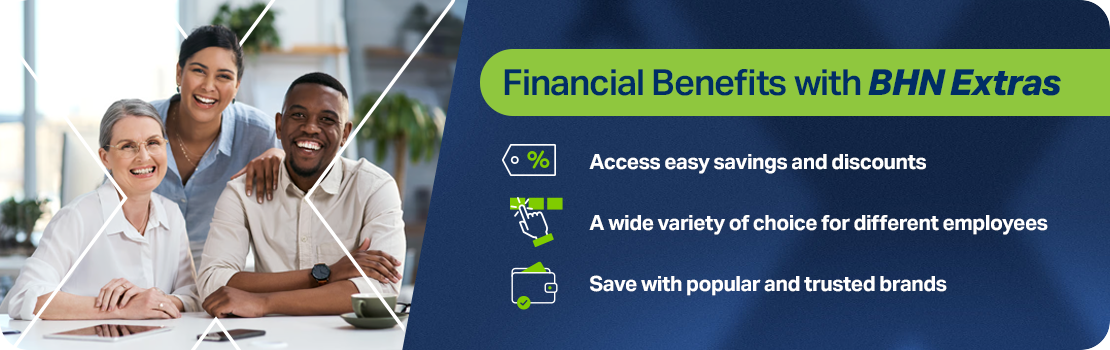
Through BHN Extras, employees can access discounted gift cards and cashback savings opportunities through trusted retailers. That means routine spending on things you were going to buy anyway can deliver a little more value.
Other benefits can help with bigger purchases too. Home & Tech, for example, lets eligible employees save up to 8% on thousands of products from IKEA and Currys and spread the cost through salary sacrifice. That kind of practical support makes a big difference, especially over time.
Health and wellbeing fringe benefits
Fringe benefits aren't only about saving money. They can also make it easier to look after your physical and mental wellbeing. Depending on your employer, you might have access to benefits such as:
- Discounted gym memberships
- Employee assistance programmes
- Mental health counselling
- Private medical insurance
- Dental or optical cover
- Additional wellbeing days
- Cycle to Work schemes
Through BHN Extras, MyGymDiscounts offers up to 25% off memberships at thousands of gyms, leisure centres, and other venues across the UK. Cyclescheme can also help eligible employees save up to 47% on a new bike and equipment, allowing you to prioritise a healthy commute in a more affordable way. And for support directly related to healthcare, there’s Bupa health cover which includes private medical insurance and help with everyday dental costs.
These aren't benefits you need to use just because they're available. The point is that they offer choice. If a discounted gym membership works for you, great. If cycling would save you more money and fit more naturally into your routine, that might deliver far greater value.
Just make sure you actually know what benefits you can access to reap the mental and physical benefits. Mercer's 2025 Health on Demand research, which included 1,000 UK employees, found that 48% considered communications about their benefits unengaging. That's a useful reminder that, sometimes, the biggest problem isn't a lack of benefits but employees not knowing what's available or how to use them.

Salary sacrifice fringe benefits
As touched upon a little bit earlier, some fringe benefits work through salary sacrifice. With an eligible salary sacrifice arrangement, you agree to give up part of your gross salary every month in return for a non-cash benefit. Depending on the scheme and your circumstances, this can result in tax and National Insurance savings.
Of the benefits we’ve mentioned throughout this guide, these are the salary sacrifice fringe benefits available through BHN Extras:
- Cyclescheme: Save up to 47% on a new bike and eligible cycling equipment, with the cost spread through salary sacrifice.
- Home & Tech: This salary sacrifice scheme helps you save up to 8% on a wide range of purchases related to home and technology such as new phones, laptops, appliances, furniture, and more.
Alongside these, BHN Extras also provides access to the Green Car Benefit. This can make getting an ultra-low-emission vehicle more affordable, subject to eligibility and the scheme offered by your employer.
All that said, salary sacrifice isn't automatically the right option for everybody. Because it reduces your contractual cash salary, you should take the time to learn more about how a salary sacrifice arrangement could affect things such as statutory payments, pension calculations, or borrowing assessments before applying.
Fringe benefits and workplace culture
When asking “what are fringe benefits?”, it's easy to focus entirely on pounds and percentages. However, benefits can tell you something broader about the culture of the organisation you work for.
A company that offers choice, communicates its benefits clearly, and regularly asks employees what they need is sending a message: your experience at work matters. That's especially important because different employees value different things.
A WTW UK survey found that, when employees had the greatest choice over their benefits, 72% said their benefits met their needs and 76% would recommend their employer as a good place to work. This shows that choice matters just as much as quantity, and how a massive selection of benefits you’ll never use aren't necessarily worth as much as a few that genuinely make your life easier.

How can employees take advantage of fringe benefits?
Having good fringe benefits is one thing, but actually using them is another. Here's how to make sure you're not leaving useful savings and support untouched.
1. Find out exactly what you're entitled to
Start with your employer's benefits portal, intranet, or HR team. Don't assume the benefits mentioned when you joined are still the only ones available. Packages change and new schemes launch, while eligibility can change over time.
If your employer uses BHN Extras, having benefits in one easy-to-use platform makes it much easier to see what's available rather than hunting through different systems.
2. Prioritise benefits you'd actually use
Free perks aren't automatically valuable perks. Look at what you're already spending money on, whether it’s groceries, technology, a gym membership, or commuting. Then see whether your workplace benefits can reduce those existing costs.
This is where fringe benefits can become part of your everyday finances rather than something you forget exists after induction week.
3. Understand how each benefit works
Check whether a benefit is free, discounted, paid through salary sacrifice, or treated as a taxable benefit. Tax rules differ between benefits. HMRC publishes specific guidance on company benefits and expenses, so don't assume every workplace perk is automatically tax-free.
For salary sacrifice arrangements in particular, read the terms and understand the effect on your pay before applying.

4. Stack up smaller everyday savings
You don't necessarily need one huge employee benefit to make your package worthwhile. Regular cashback, discounted shopping, cheaper fitness memberships, and savings on commuting can collectively make a meaningful difference over a year.
With BHN Extras, employees can access benefits connected to household names including IKEA, Currys, Argos, Sainsbury's, Primark, and M&S. If you're already spending with those types of retailers, checking your benefits before buying can become a simple money-saving habit.
5. Revisit your benefits when life changes
The benefit you ignored two years ago might suddenly become very useful. Moving house, starting a family, changing your commute, taking up exercise, or replacing an old laptop can all change which benefits matter most to you.
So don't think of your fringe benefits as a fixed checklist. Instead, review them whenever your priorities change.
What are fringe benefits worth to you?
There isn't one answer around the value of fringe benefits. Ultimately, a benefit is valuable when it solves a real problem, saves you money, or improves your life. For one employee, that might mean saving on commuting through a new bike or vehicle. For somebody else, it could be cutting the cost of groceries, spreading the cost of new technology, or paying less for their gym membership.
That's why the best first step is simple: look at what's already available to you.
BHN Extras is here to make that as straightforward as possible with money-saving workplace benefits that are all easily accessible through one free platform. From cashback and trusted retail brands to bikes, tech, and wellbeing, we’re all about helping you get more from your employment package without making benefits complicated.
To learn more, call BHN Extras on 0208 159 9430, visit our Contact Page, or email us at enquiries@workplaceextras.com and find out what benefits you may be able to access to make your life easier.
FAQs: What are Fringe Benefits?
Are fringe benefits included in an employment contract? +
Some can be contractual, while others are discretionary and may be changed or withdrawn by an employer. Check your employment contract, staff handbook, or benefit terms if you need to know whether a specific fringe benefit is guaranteed.
Are fringe benefits taxable in the UK? +
Some are. HMRC applies different tax rules depending on the benefit provided. Certain benefits are exempt, while others may create an Income Tax or National Insurance liability. Check the rules for the individual benefit rather than assuming all perks receive the same tax treatment.
What is the difference between fringe benefits and benefits in kind? +
The terms sometimes overlap. A benefit in kind generally describes a non-cash benefit provided by an employer that may have tax implications. “Fringe benefits” is a broader everyday term for additional perks or benefits received alongside salary.
Can part-time employees receive fringe benefits? +
Yes. Part-time employees can receive workplace benefits, although eligibility and access may depend on the particular scheme and employer rules. Part-time workers also have legal protection against being treated less favourably simply because they work part time.
Can remote employees receive fringe benefits? +
Yes. Many fringe benefits don't depend on being physically present in an office. Cashback, shopping discounts, wellbeing services, and certain salary sacrifice arrangements may all be accessible to remote employees where eligibility requirements are met.
Do fringe benefits count towards minimum wage? +
Employers generally can't simply count the value of most benefits towards National Minimum Wage pay. Salary sacrifice arrangements can also require additional checks because they must not reduce applicable cash pay below minimum wage requirements.
Can employees ask for different fringe benefits? +
Absolutely. Employee feedback can help employers understand which benefits people actually value. If there's a benefit you think would improve your financial, physical, or mental wellbeing, raising it through HR surveys or employee forums can help demonstrate demand.
Do you lose fringe benefits when you leave a job? +
Usually, employer-provided benefits end when your employment ends, although the exact timing depends on the benefit and its terms. Some schemes may have specific arrangements covering outstanding payments, ownership, or continued access.
Are bonuses considered fringe benefits? +
Usually not in the same sense. A cash bonus is normally treated as additional earnings and taxed through payroll. Fringe benefits more commonly refer to non-salary perks, services, discounts, or non-cash benefits provided alongside your normal remuneration.
Should you compare fringe benefits when considering a job offer? +
Yes. Look beyond headline salary and consider the total package. Useful discounts, flexibility, pension contributions, wellbeing support, or salary sacrifice benefits could materially change the overall value of one job offer compared with another.
You might also like these articles...

Staff Recognition Ideas: Examples of Non-Financial Rewards for Employees
Read the article
What are Fringe Benefits and How Can Employees Take Advantage?
Read the article
How to Build Team Morale: A Remote Team Building Guide
Read the article